Vénus Noire by Mitchell Robin;Newman Richard;Rael Patrick;Sinha Manisha;
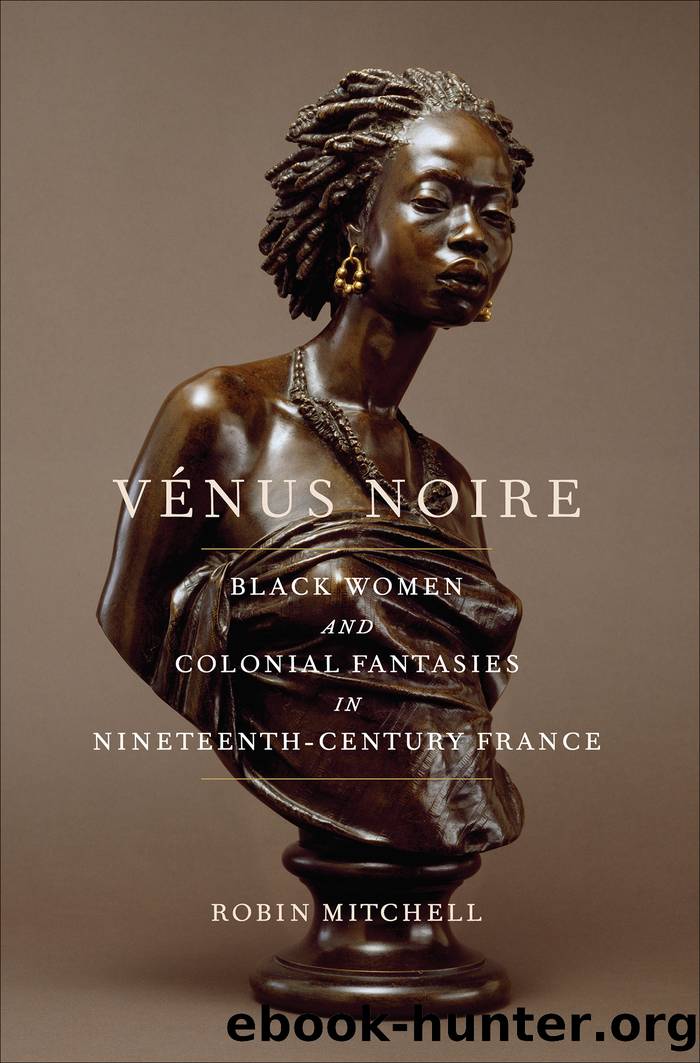
Author:Mitchell, Robin;Newman, Richard;Rael, Patrick;Sinha, Manisha;
Language: eng
Format: epub
Publisher: University of Georgia Press
Published: 2020-01-14T16:00:00+00:00
OTHER REPRESENTATIONS OF OURIKA
Literary representations of Ourika appeared in three poems: Delphine Gayâs âOurika élégieâ (Ourika Elegy; 1824); Pierre-Ange Vieillardâs âOurika, stances élégiaquesâ (Ourika, Elegiac Stanzas; 1824); and Gaspard de Ponsâs âOurika, lâafricaineâ (Ourika, the African; 1825).48 All of the poems followed Durasâs basic premise: Ourika falls in love with her âbrotherâ Charles, discovers her blackness, realizes that her race precludes a relationship with him, undergoes an existential crisis, and finally becomes ill and dies. All of her issues are connected to Charles. Gayâs and Ponsâs renditions give much attention to Charlesâs wife, who is somewhat peripheral for Duras. In so doing, these authors allow a black woman to speak of and reinforce white womanhood in the same way that they, through their own white subjectivity, speak of a degraded black womanhood.
Gay, a popular writer who read several times at Durasâs salon, positions Ourika (like Duras, to whom Gay dedicates the poem) as floundering under the realization of her difference. In her despair, she rejects Charlesâs attempt at proper inclusion in his life: âThe ingrate! He calls me his sister!â Although Ourika believes that her heart is pure and that there is ânobilityâ in her suffering, she ungratefully and rudely turns her back on the possibility of French familial bliss as Charlesâs sister, choosing to exile herself and to die. Gay gives Anaïs a great deal of agency that she lacks in the novel. According to Ourika, Anaïs, unlike her rather clueless bridegroom, âhad seen my tears and had understood them,â realizing that Ourika loves Charles. Demonstrating true Christian charity, Anaïs feels pity for Ourika rather than needless jealousy: Anaïsâs whiteness trumps Ourikaâs blackness.49
The poem is structured around metaphors of seeing and blindness. Ourikaâs ability to see her own blackness and her unsuitability for Charles sends her to the convent. Charlesâs blindness prevents him from seeing Ourika or her love for him. And an ability to see and understand Ourikaâs feelings for Charles allows Anaïs to be benevolent. Like Duras, Gay concerns herself with the dynamics of the love story while barely touching on the realities of Ourikaâs enslavement. The poem is equally about Anaïsâs suitability as a mate for Charles. All the elements of proper French womanhood are here: Anaïs is kind, watchful, and demure; most important, she instinctively understands that Ourikaâs blackness eliminates her from white feminine competition.
Pons knew of Gayâs poem and found it âcharming,â yet his interpretation of Ourikaâs story, as T. Denean Sharpley-Whiting notes, is steeped in the language of black female hypersexuality and rapid black degeneration.50 In Ponsâs rendition, because Ourika can never have the love of Charles, her transformation into a cultured Frenchwoman is revealed as farce, mimicry. Ourika brazenly offers herself and a hundred other black women to Charles: âThere, a hundred black beauties will come to lust after your choice; / It is I who will please you, as I am the most beautiful.â51 But he turns away, choosing the white Anaïs instead. His refusal both confounds and infuriates Ourika, causing her to berate him and then beseech his pardon.
Download
This site does not store any files on its server. We only index and link to content provided by other sites. Please contact the content providers to delete copyright contents if any and email us, we'll remove relevant links or contents immediately.
Personalized inhaled bacteriophage therapy for treatment of multidrug-resistant Pseudomonas aeruginosa in cystic fibrosis by unknow(209585)
CONSORT 2025 statement: updated guideline for reporting randomized trials by unknow(102492)
Critical evaluation of the ProfiLER-02 study design and outcomes by Vivek Subbiah & Razelle Kurzrock(102021)
Cardiac gene therapy makes a comeback by Oliver J. Müller & Susanne Hille & Anca Kliesow Remes(101812)
Whisky: Malt Whiskies of Scotland (Collins Little Books) by dominic roskrow(74598)
Unveiling the design rules for tunable emission in graphene quantum dots: A high-throughput TDDFT and machine learning perspective by Şener Özönder & Mustafa Coşkun Özdemir & Caner Ünlü(50987)
A yeast-based oral therapeutic delivers immune checkpoint inhibitors to reduce intestinal tumor burden by unknow(40364)
Covalent hitchhikers guide proteins to the nucleus by Alexander F. Russell & Madeline F. Currie & Champak Chatterjee(40288)
Meet the Authors: Christopher R. Mansfield and Emily R. Derbyshire by Christopher R. Mansfield & Emily R. Derbyshire(40190)
Alkaline-earth metals promote propane dehydrogenation with carbon dioxide through geometric effects: Altering the reaction pathway by unknow(32807)
Induced iron vacancies boosting FeOOH loaded on sustainable Fenton-like collagen fiber membrane for efficient removal of emerging contaminants by unknow(32604)
Efficient electric-field-assisted photochemical conversion of methane to n-propanol exclusively over penetrated TiO2Ti hollow fibers by Guanghui Feng(32524)
Bi2SiO5 nanosheets as piezo-photocatalyst for efficient degradation of 2,4-Dichlorophenol by Hangyu Shi & Yifu Li & Lishan Zhang & Guoguan Liu & Qian Zhang & Xuan Ru & Shan Zhong(32460)
A novel NDIPTA organic heterojunction photocatalyst with built-in electric field for efficient hydrogen production by Jiahui Yang & Baojun Ma & Yongfa Zhu(32435)
Enhanced conversion of methane to liquid-phase oxygenates via hollow ferrite nanotube@horseradish peroxidase based photoenzymatic catalysis by Jun Duan & Shiying Fan & Xinyong Li & Shaomin Liu(32398)
Ordered macroporous superstructure of defective carbon adorned with tiny cobalt sulfide for selective electrocatalytic hydrogenation of cinnamaldehyde by Xiao-Shi Yuan & Sheng-Hua Zhou & San-Mei Wang & Wenbo Wei & Xiaofang Li & Xin-Tao Wu & Qi-Long Zhu(32325)
What's Done in Darkness by Kayla Perrin(27237)
Topological analysis of non-conjugated ethylene oxide cored dendrimers decorated with tetraphenylethylene: Insights from degree-based descriptors using the polynomial approach by A Theertha Nair & D Antony Xavier & Annmaria Baby & S Akhila(26619)
Investigation of mechanical and self-healing properties of hydroxyl-terminated polybutadiene functionalized with 2-ureido-4-pyrimidinone by Mohsen Kazazi & Mehran Hayaty & Ali Mousaviazar(26548)
